
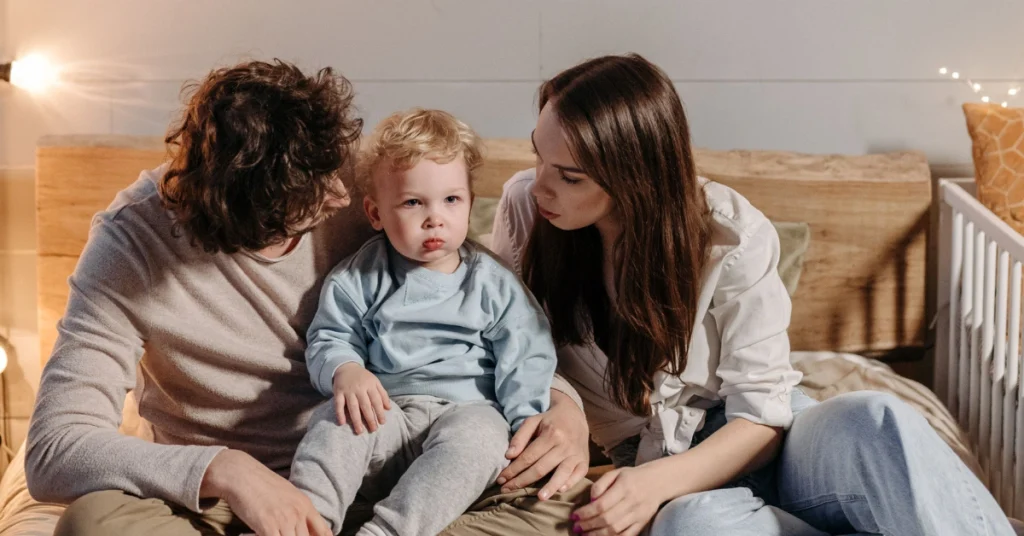
Here’s something that took me years to really understand: the moments that shape a child’s development aren’t the big ones. They’re not the birthday parties or the family vacations or the perfectly planned learning activities. They’re the small, repeated interactions — the way you respond when he spills the juice, the way you handle her third question about why the sky is blue, the tone of your voice when you’re tired.
That’s the good news and the hard news all at once. Because it means we don’t have to be extraordinary parents to raise capable, confident kids. But it also means the small habits we don’t think much about are quietly doing the heaviest lifting. After a decade of watching toddlers in classrooms, playgroups, and my own living room, here are the mistakes I see most often — the ones that actually affect how kids grow.
Speaking for them
You know the scene. Someone at the grocery store asks your three-year-old how old she is, and before she can answer, you jump in. “She’s three! Say three, Lily. Can you say three?”
I did this constantly with Noah when he was little. It felt polite. It felt helpful. It was neither.
When we answer for our kids, we teach them their voice doesn’t matter as much as ours. Over time, that quietly erodes their willingness to speak up, to try words they’re not sure of, to engage with adults on their own. Give them the pause. Even if they say nothing. Even if they hide behind your leg. The silence is doing real work.
Rescuing them from every hard feeling
A tower falls. A cracker breaks. A sibling grabs the toy. And every parenting bone in our body wants to fix it, fast.
But frustration, disappointment, and boredom aren’t problems — they’re the exact conditions kids need to build emotional regulation. If we sweep in every time, we short-circuit the process. In my classroom years, the kids who struggled most with resilience weren’t the ones with hard home lives. They were often the ones whose parents worked overtime to keep them comfortable.
Let the tower stay fallen for a minute. Let the cracker be broken. Sit near her while she cries about it. That’s not neglect. That’s the whole lesson.
Filling every silence with input
Modern parenting comes with a strong pull to narrate, teach, and enrich every waking moment. Educational apps in the car. Flashcards at breakfast. Pointing out shapes on every walk.
Here’s the thing — a toddler’s brain grows most in the quiet moments. When she’s staring at a bug on the sidewalk for four minutes, she’s doing developmental work you cannot replicate with a lesson. When he’s pushing a truck around the same three feet of carpet, over and over, his brain is building patterns of focus and repetition that will carry him through school one day.
Not every moment needs to be enriching. Some of them just need to be his.
Punishing curiosity
She dumps the entire bin of blocks on the floor. He unrolls the toilet paper. She takes every book off the shelf and stacks them on the dog.
I know. It’s maddening. But most of what looks like “bad behavior” in a toddler is actually experimentation. She’s not being defiant — she’s testing what happens when you tip a bin. He’s not ruining the bathroom — he’s discovering that a roll unspools.
If we shut every exploration down with a sharp no, we teach them that curiosity has a cost. You can absolutely set limits (we don’t unroll the toilet paper; here’s a roll of yarn you can unwind instead), but the tone matters. Redirect the behavior without shaming the impulse.
Comparing them, even out loud once
“Your brother was already talking at this age.”
“Your friend Mia is already using the potty.”
We say these things half-jokingly, or as motivation, or just as a passing observation. Toddlers hear all of it. And they store it.
Kids develop on wildly different timelines, and comparison — spoken or implied — can quietly plant the idea that they’re behind, less than, not enough. Noah walked at ten months. Lily at fifteen. They are both fine. Your kid is on her own clock. Trust it, and don’t accidentally teach her to doubt it.
Modeling what we don’t want to see
Toddlers are professional imitators. They will absorb the way you handle frustration, the way you talk about your body, the way you speak to your partner when you’re annoyed, the way you react when you’re stuck in traffic.
You can teach patience for years, but if she watches you slam a cupboard when the coffee spills, she’s learning something more powerful than anything you said. This isn’t about being perfect. It’s about being honest. When I lose it, I try to circle back — “Mom got frustrated and used a big voice. That wasn’t the best way to handle it.” Kids don’t need flawless parents. They need parents who repair.
Conclusion
If you’re reading this and mentally cataloguing every mistake you’ve made this week — stop. Every parent I’ve ever known, myself very much included, has done every single thing on this list. Development isn’t derailed by a bad Tuesday. It’s shaped by patterns, and patterns are always adjustable.
The best thing you can do for your toddler’s growth isn’t to become a different parent. It’s to notice, adjust, and keep showing up. That’s it. Kids who grow into confident, curious, emotionally steady humans aren’t raised by perfect parents. They’re raised by parents who paid attention.
FAQ
At what age do parenting mistakes start affecting development?
From very early on — but not in the dramatic way people fear. Development is shaped by the pattern of your interactions over months and years, not by any single moment. Consistency matters far more than perfection at any age.
Can I undo the effects of past parenting mistakes?
In almost every case, yes. Kids are extraordinarily adaptive, and they respond to consistent new patterns quickly. Repair conversations, calmer responses, and follow-through go a long way — often within weeks.
How do I know if I’m affecting my child’s development negatively?
Watch the patterns, not the incidents. If your toddler seems generally curious, comes to you when upset, and bounces back from small frustrations, you’re doing the core work well — even on the days it doesn’t feel like it.
Does yelling really affect toddler development?
Occasional yelling in a warm, connected home isn’t damaging. Chronic yelling, especially without repair afterward, can affect how kids handle stress and conflict. The fix isn’t never yelling — it’s noticing, apologizing when needed, and slowly building calmer responses over time.